
University of Cyprus
Project Coordinator of ISMED-CLIM · Nicosia, Cyprus





 18 researchers →
The Respiratory Physiology Laboratory at the Medical School of the University of Cyprus, led by Professor Panayiotis Yiallouros, focuses on respiratory health, as well as public and environmental health research. Its activities integrate clinical, epidemiological, exposure assessment, and digital health approaches.
In recent years, the laboratory has coordinated several research projects examining the health impacts of air pollution, heat stress, and desert dust storms. It also collaborates closely with carers and patients affected by common conditions such as chronic respiratory and cardiovascular diseases, as well as rare genetic disorders including Primary Ciliary Dyskinesia and Cystic Fibrosis.
By bridging respiratory medicine, environmental health, and digital technologies, the laboratory contributes to the development of innovative mitigation strategies, supports evidence-based policy, and advances improvements in health outcomes in Cyprus and beyond.
Coordinating a Mediterranean-wide response
Within the Horizon Europe project ISMED-CLIM, UCY acts as Project Coordinator, under the leadership of Professor Panayiotis Yiallouros.
UCY participates in ISMED-CLIM through its Medical School, Department of Civil and Environmental Engineering and Department of Social and Political Sciences. Through its role as Project Coordinator, UCY is responsible for the overall project management and successful completion of technical tasks, network coordination, budget allocation and reporting. Additionally, it also undertakes the performance of Living Lab 2 (intervention study in pregnant women) and Living Lab 3 (intervention study in older adults with hypertension) in Cyprus and supports implementation of Living Lab 4 (prospective feasibility study for reduction of leishmaniasis transmission risk) and Living Lab 5 (adaptation of a Climate Resilience for Frontline Clinics toolkit for the Mediterranean). Finally, it also participates in the development of the project’s Early Warning and Response System and Policy Dashboard.
As coordinator, UCY provides overall scientific and operational leadership, ensuring that all project activities are aligned and effectively implemented. UCY contributes to:
Epidemiological modelling
Modelling the health impacts of climate change across the Mediterranean.
Risk assessment
Assessing risks linked to temperature, air pollution, wildfires and flooding.
Policy tools
Developing evidence-based recommendations and tools for decision makers.
Testing solutions in real-life conditions
Pregnant women
A randomized controlled trial testing early warning and practical interventions to reduce exposure to heat and air pollution during pregnancy.
Explore Living Lab 2 → LIVING LAB 3 · NICOSIAOlder adults with hypertension
A trial with older adults living with hypertension, testing how early warnings and simple actions can protect health on high-risk days.
Explore Living Lab 3 →These activities focus on testing early warning systems and practical interventions to reduce exposure to climate-related risks. UCY also supports the implementation of Living Lab 4 (leishmaniasis transmission risk) and Living Lab 5 (climate resilience toolkit for frontline clinics).
Turning evidence into everyday protection
UCY supports the development of AI-enhanced Early Warning and Response Systems and contributes to the ISMED-CLIM digital platform, which connects climate data, health information, and decision-support tools.
By combining research, innovation, and real-world implementation, UCY helps ensure that project results are translated into practical solutions for:
- Climate & health dataExposure, weather and health information brought together.
- AI-enhanced early warningAlerts that anticipate high-risk days for vulnerable people.
- Digital platform & dashboardDecision support for health services and authorities.
- Action on the groundPractical guidance tested in the Living Labs.
Through its role in ISMED-CLIM, the University of Cyprus contributes to building more resilient communities across the Mediterranean, supporting the adoption of adaptation solutions and strengthening preparedness for climate-related health risks.
Meet the UCY team
Leadership & project management
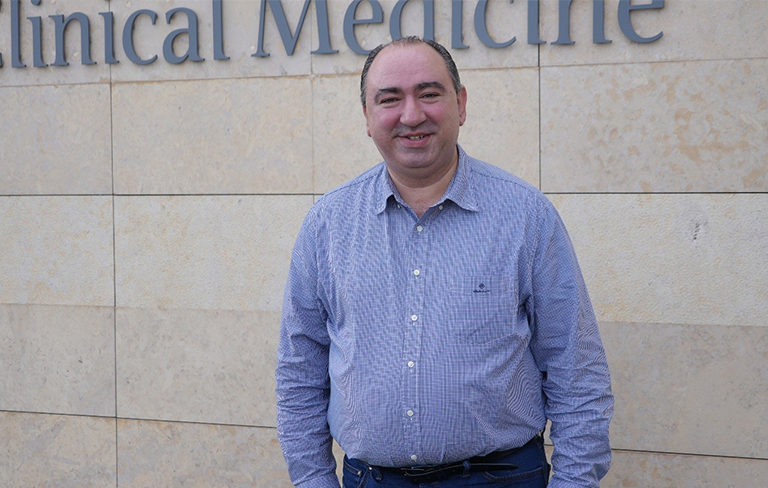
Dr Panayiotis Yiallouros is Professor of Pediatrics and Head of the Respiratory Physiology Laboratory at the Medical School of the University of Cyprus, a position he has held since 2016. He is also the founder and a Consultant of the Pediatric Pulmonology Clinic at the Archbishop Makarios III Hospital in Nicosia, which serves as the tertiary referral center for pediatric respiratory diseases in Cyprus and is a member of the European Reference Network for rare lung diseases (ERN-LUNG).
Dr Yiallouros studied Medicine at the University of Athens and completed his training in pediatric pulmonology in St Thomas’ Hospital and Great Ormond Street Hospital for Sick Children in London. His research focuses on pediatric lung diseases as well as environmental and climate-related health risks.
Over the last 20 years, Prof. Yiallouros has acquired more than twelve competitive European and national research grants in the fields of respiratory medicine, environmental and public health (HORIZON EUROPE, EU FP7, LIFE+, IDEK, Cyprus Ministry of Health) bringing external funding exceeding 10 million euros. He currently leads the ISMED-CLIM project, which aims to implement a wide array of adaptation solutions to mitigate the health effects of climate change across the Mediterranean region.
Antonis Michanikou holds a BSc in Chemistry, an MSc in Biomedical Sciences, and is currently pursuing a PhD in Electrical Engineering at the University of Cyprus. Since 2018, he has been affiliated with the Respiratory Physiology Laboratory (Medical School, University of Cyprus), specializing in real-world environmental health research using home-based and wearable sensing to collect and analyze personal-level exposure and physiological data.
He has contributed to national and international projects focused on vulnerable populations, delivering practical, evidence-based interventions to mitigate adverse climatic and environmental exposures, and currently serves as Project Manager of ISMED-CLIM.
Dr Pinelopi Anagnostopoulou is a Pediatrician – Pediatric Pulmonologist and Assistant Professor in Pediatrics at the Medical School of the University of Cyprus.
Her research focuses on the respiratory physiology and lung function testing in infants and children, and the lung development in health and disease.
She carries out clinical and translational studies on diagnostics and monitoring of chronic respiratory diseases (cystic fibrosis, primary ciliary dyskinesia, lung disease of prematurity, etc). In the ISMED-CLIM project she is actively involved in the project management team and in the assessment of the clinical outcomes of the living labs studies.
Dr Panayiotis Kouis holds a PhD in Environmental Health and is a Visiting Lecturer at the Medical School of the University of Cyprus. He has been a member of the Respiratory Physiology Laboratory since 2017 and a collaborator of the Laboratory of Medical Statistics, Epidemiology and Public Health since 2021. Since 2023, he is a faculty member of the Cyprus Harvard Endowment Program for the Environment and Public Health.
He is involved in the study of respiratory and cardiovascular diseases with a special interest in the health impact of environmental exposures and climate change on sensitive subgroups.
His experience includes the performance of observational studies and randomized trials involving children or adults and the integration of exposure and health monitoring using wearable and other sensors. In the ISMED-CLIM project, he participates in the project management team and the implementation of the Living Labs as well as supports the development of the project’s Policy Dashboard.
Living Labs & clinical research
Dr Maria Kakkoura is currently a Marie Skłodowska-Curie Actions (MSCA) cofund Fellow at the Medical School of the University of Cyprus, implementing and coordinating the “Clean Air for Rare MUcociliary Clearance dIsorders” (CARMUCI) project. She has over ten years of experience in public and population health projects.
Previously, she worked as Epidemiologist at the Oxford Population Health of the University of Oxford, where she worked on large, biobank prospective studies and multidisciplinary projects.
Her expertise includes conducting and managing randomised trials, analysing big data, and performing epidemiological research on the health effects of environmental and lifestyle factors. In the ISMED-CLIM project, Maria is involved in the implementation of the Living labs, including recruitment of participants and assessment of health outcomes.
Dr Nicolas C. Nicolaides is a pediatrician – pediatric endocrinologist currently working as an Assistant Professor in Pediatrics in the Medical School of the University of Cyprus. His research interests include stress, childhood obesity and hormone signaling.
In the ISMED-CLIM project he is actively involved in the assessment of the clinical outcomes of the living labs studies.
Dr Nicolaos Nicolaou is a Consultant Allergist for Children and Adults at the N Asthma and Allergy Center in Limassol, Cyprus, and a Clinical Professor of Allergy and Paediatric Allergy at the University of Nicosia Medical School.
Within the ISMED-CLIM project, Dr Nicolaou is involved in Living Lab 2, serving as a protocol advisor and acting as a liaison between the research team and obstetricians, facilitating communication and engagement with participating pregnant women.
Dr Panagiotis Bargiotas is an Assistant Professor of Neurology at the Medical School of the University of Cyprus. Dr Bargiotas’ research focuses on the neurophysiology of sleep-wake disturbances (including REM Sleep Behavior Disorder, sleepiness and sleepiness perception, fatigue and apathy) in patients with neurodegenerative disorders and mainly in those with Parkinson’s disease.
Research methodology includes the use of specific questionnaires, sleep-wake diaries, behavioral tests, wearables (advanced actigraphy) and sleep neurophysiology (polysomnography and special EMG protocols, MSLT, MWT). In the ISMED-CLIM project, he is actively involved in the clinical assessments of the living labs studies, including the assessment of sleep quality and blood pressure using advanced actigraphy.
Dr Leonidas Ioannou is an environmental and occupational physiologist with expertise in Kinesiology, Health Sciences, Physiological Modelling, and Environmental/Occupational Physiology.
He holds two PhDs and a Habilitation in Physiology and serves as Assistant Professor at the Jožef Stefan Institute (Slovenia) and Visiting Lecturer at the Medical School of the University of Cyprus. In ISMED-CLIM, he supports data collection, curation, and interpretation.
Mikaela Sekkidou is a Clinical Dietitian and a PhD candidate with special interest in Food Allergy. Within the ISMED-CLIM project, she is responsible for participant recruitment and follow-up in Living Lab 2 (Pregnant Women).
She is also involved in Living Lab 5, contributing to the execution of the systematic review on current practices for healthcare system resilience, the international survey on healthcare practices related to climate change risks, and the adaptation of the Americares Resilience for Frontline Clinics Toolkit.
With a background in Nursing and specialization in Environmental sciences, Thaleia contributes to the ISMED-CLIM project through equipment installation, assessment of exposure parameters and clinical outcomes.
She also monitors participant compliance, provides technical support, and maintains regular communication to ensure data quality and participant well-being.
With a background in biology, Ioannis Xinaris contributes to the ISMED-CLIM project by installing research equipment, evaluating exposure conditions, and supporting the monitoring of clinical outcomes.
He also oversees participant adherence and maintains structured communication to ensure data integrity and participant well-being.
Epidemiology & environmental science
Dr Georgios Nikolopoulos is an Associate Professor of Epidemiology and Public Health at the Medical School of the University of Cyprus. He leads the Laboratory of Medical Statistics, Epidemiology and Public Health and coordinates the MSc in Methods in Medical Research program. He is certified in Public Health (CPH) by the US National Board of Public Health Examiners, a Fellow of the American College of Epidemiology (FACE), and Vice President of the Public Health Epidemiology Section of the European Public Health Association.
His research interests include infectious disease epidemiology and prevention with an emphasis on chronic infections (HIV and hepatitis viruses), evidence synthesis, research methods, environmental epidemiology, health policy and services research (implementation and evaluation), and guidelines development and adaptation. In the ISMED-CLIM project, he is actively involved in the study of the associations of climate change parameters with risk of non-communicable diseases across the Mediterranean region.
Prof. Dr Marina Neophytou is a Professor of Environmental Engineering leading the Environmental Fluid Mechanics (EFM) Laboratory – Isle of Excellence and also the elected Dean of the Faculty of Engineering of the University of Cyprus (2023–26). In ISMED-CLIM, she contributes scientific leadership in urban microclimate modelling, air quality, and climate adaptation strategies, supporting evidence-based policy and resilience planning.
Dr Petros Mouzourides is a Senior Postdoctoral Researcher at the Environmental Fluid Mechanics (EFM) Laboratory – Isle of Excellence at the University of Cyprus, specializing in environmental fluid mechanics, urban air quality, and microclimate modelling. In the ISMED-CLIM project, he contributes to atmospheric modelling and the integration of observational and modelling tools for assessing climate impacts and supporting evidence-based adaptation strategies in the Mediterranean region.
Social sciences
Venetia Papa (Ph.D.) is an Assistant Professor in Journalism and Digital Media at the Department of Communication and Internet Studies, at the Cyprus University of Technology. She has previously worked at the Department of Social and Political Sciences at the University of Cyprus.
Venetia’s research interests are situated at the intersection of new media technologies, journalism, and citizenship. Her work delves into topics such as algorithmic curation, media and journalism, exploring how algorithms and automation impact news production and the public’s engagement with media. In the ISMED-CLIM project, she is the coordinator of the social sciences team researchers.
Iasonas Lamprianou is Professor of Quantitative Methods at the University of Cyprus. He specializes in the operationalization and measurement of latent variables in the social sciences. Iasonas has a long-standing interest in the application of Rasch models on empirical data and has published widely in diverse disciplines such as education, political science, sociology, and psychology.
In the ISMED-CLIM project, he is involved in the engagement of the social stakeholders and in assessing how various socioeconomic factors affect the public’s response to the climate change-related health risks.
Dr Theodoros Kyriakides is a social anthropologist and research associate at the University of Cyprus Medical School, contributing to the ISMED-CLIM project on climate change and crisis management.
His work focuses on climate and health policy, societal resilience, and the interaction between governance, risk, and lived experience in the Mediterranean. He combines qualitative research, policy analysis, and stakeholder engagement to support evidence-informed adaptation strategies.